A manufacturer choosing industrial waste management services should confirm that the provider can classify each waste stream, move it with proper paperwork and deliver it to a plant authorised for recovery or disposal.
This guide follows the chain from the factory yard to the treatment plant. It sits within the wider set on waste to energy and environmental services, and hazardous streams have their own treatment in how is hazardous waste managed.
- Classify before you collect. A provider can only route a stream correctly if the producer has identified what it is.
- Buy by waste type, not by price list. Volume and separation requirements decide which service fits.
- Keep the trail. Transport paperwork and proof of final destination protect the producer, not only the provider.
When you are not sure which services you need
Industrial waste management companies offer several distinct services, and most manufacturers need a mix rather than a single contract. The practical question is which service matches each stream leaving the site.
Scheduled container collection
For routine, non-hazardous residues and recyclables, WM describes regular trash and recycling service with various dumpster sizes and pickup schedules. This suits steady, predictable output. Container size and pickup frequency are the levers: oversized containers waste money, undersized ones lead to overflow and mixed streams.
Liquids, sludges and chemicals
Wet and chemical streams need different equipment. MCF Environmental lists chemical waste pickup, transportation and disposal, vacuum truck removal of liquid and sludge, pit and drain cleaning, and lab pack services with laboratory waste management including chemical disposal. If a process produces tank bottoms, wash-down sludge or laboratory residues, a provider offering only skips is not enough.
Universal waste and recycling programmes
MCF also lists turnkey recycling for batteries, electric switches, fluorescent tubes and light ballasts. Small, regulated items such as these are easy to overlook, and a provider with a ready programme saves the site from improvising storage and transport.
Whatever the mix, WM’s Bay Area guidance advises selecting services based on both the amount of material generated and the way it must be separated. A high-volume single-material stream and a low-volume mixed one call for different contracts.
When the waste is not clearly classified
Classification comes before collection, because it determines which provider, vehicle and plant may handle the waste. Italian law applies the definitions of waste, hazardous waste, producer and holder in article 183 of Legislative Decree 152/2006, so a producer should be able to say which side of those definitions each stream falls on.
The duty sits with the producer. Treat a provider’s offer to “sort it out on collection” with caution; an independent classification, written down per stream, is the safer starting point for special and industrial waste alike.
Segregation and labelling on site
Separate bays for each stream keep classification meaningful. Mixed metals, oils, chemical residues and general rubbish should not share a container, because one contaminated load can change how the whole load must be handled. California practice also expects each bin to be identified and labelled before any hazardous waste is transported off-site.
How waste moves from your yard to final treatment
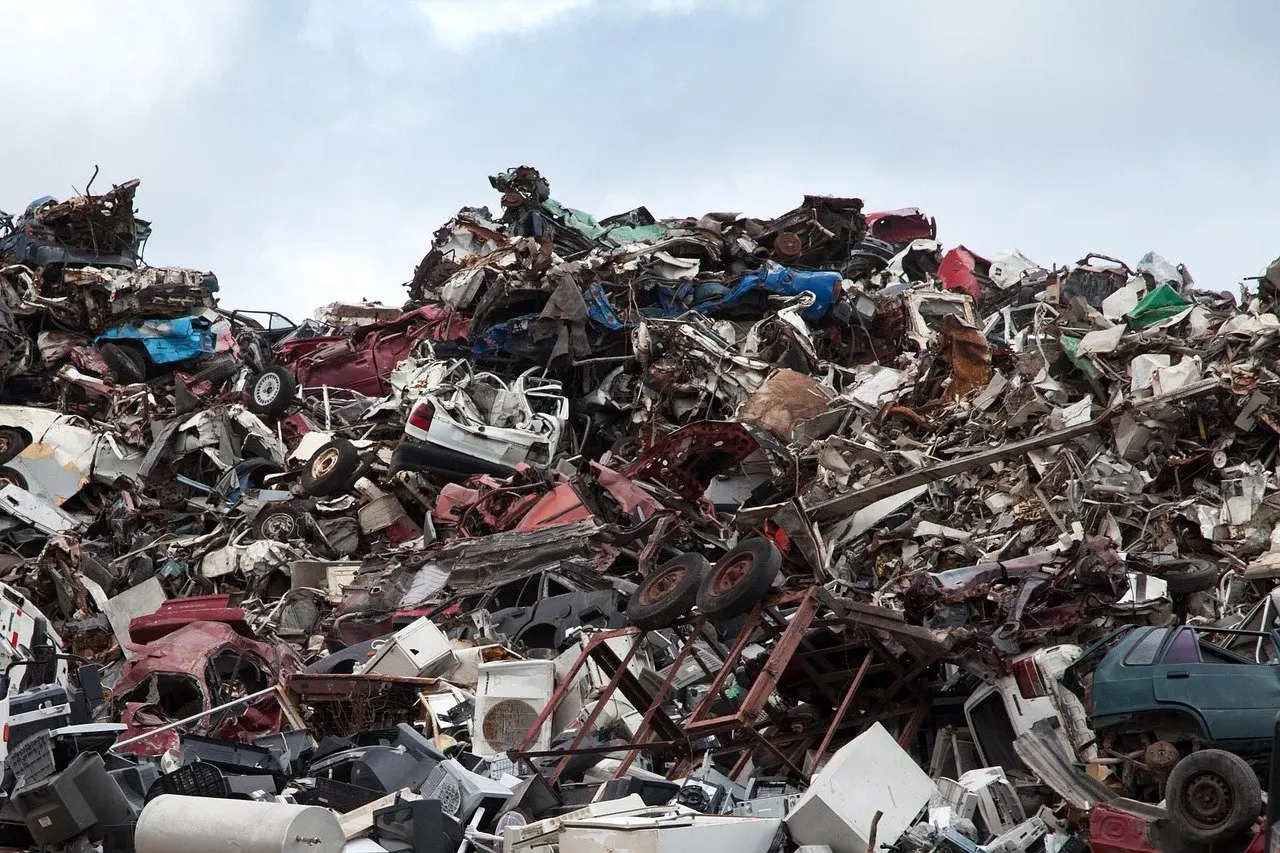
Industrial waste is collected on site, taken to a facility that accepts that stream, sorted or treated, and then sent on for recovery or final disposal. Each handover is a point where the producer can check that the next party is the right one.
Before the vehicle arrives
WM advises that local collection requirements and facility acceptance rules should be checked before setting out or transporting waste. For a manufacturer, that means asking the provider in advance which plant will take each stream and whether that plant accepts it.
At the treatment plant
A well-run facility separates what can be reused from what cannot. WM’s Davis Street facility is described as recovering materials for reuse, recycling or composting while transferring residual trash to a landfill. The order of preference behind that approach is the waste hierarchy, which is why a provider’s recovery routes matter as much as its collection fleet.
Paperwork that follows each load
Producers document waste movements with a transport form completed for every load, plus records that show the waste reached its destination. The form links the load to its producer, the carrier and the receiving plant, and it is the first thing to check if a dispute or inspection arises.
California practice gives a clear picture of what compliant handling involves: accurate waste identification and completed hazardous waste manifests, alongside holding a hazardous waste EPA ID number. The Italian equivalents differ in name and detail, but the principle carries over. Ask the provider to show a blank form, explain who fills in each section, and say how the returned copy reaches you.
The same source describes the cradle-to-grave approach: the waste generator remains responsible for hazardous waste from the moment it is produced until final disposal. A producer who files transport forms without ever confirming the final destination has only half the protection the paperwork can offer.
Checking a provider before you sign
Choosing a provider is mostly a matter of asking for evidence that each link in the chain is authorised for your specific waste. A carrier should be able to show authorisation for the kind of waste it will move, and the receiving plant for the kind of treatment or disposal it will perform. A general company profile is not a substitute.
| Problem | What to ask for | Why it matters |
|---|---|---|
| The provider cannot say how your waste is classified | A written classification for each stream | Generators must identify and characterise hazardous wastes themselves |
| You are unsure the destination plant will take the load | Written confirmation of facility acceptance rules for your stream | Acceptance rules should be checked before transport |
| It is unclear who is liable after pickup | Proof of the final destination, not only the first handover | The generator stays responsible until final disposal |
| Paperwork looks incomplete | Completed manifests or transport forms and the provider’s identification numbers | Compliant handling includes accurate manifests and an EPA ID number in California |
| The service does not match your volume or separation needs | A quote that states container sizes, pickup schedule and separation rules | Services should be chosen by quantity and separation requirements |
The checks above draw on MCF Environmental’s California compliance guidance and WM’s Bay Area guidance, both commercial providers rather than regulators.
If your team lacks the time or expertise to run these checks, an adviser can do it for you; what does an environmental consultant do explains how that support works.
Recovery versus disposal: where the rules are heading
Italian rules push industrial producers toward recovery over landfill. Legislative Decree 121/2020 ties landfill reduction to the waste recovery duties in articles 179 and 182 of Legislative Decree 152/2006. From 2030, landfill disposal of all waste suitable for recycling or recovery is banned, subject to exceptions.
For a manufacturer, the decision is clear. A provider whose routes end in landfill for streams that could be recycled is a contract risk that will grow as 2030 nears. When comparing bids, ask what happens to each stream after sorting, and prefer providers that can document recovery for metals, packaging and universal waste.
Frequently asked questions
| Question | Answer |
|---|---|
| What order of preference applies to waste handling? | WM’s regional guidance gives the hierarchy as reduce, reuse, recycle or compost, and finally dispose. |
| Can hazardous waste go through a standard landfill programme? | Not necessarily. WM states that hazardous waste is not accepted through the standard programme at its Redwood Landfill, so it needs a separate, authorised route. |
| When did Legislative Decree 121/2020 take effect? | It entered into force on 29 September 2020, following publication in the Gazzetta Ufficiale on 14 September 2020. |
| Does the 2035 landfill target apply to industrial waste? | The target in the decree concerns urban waste: the amount landfilled must fall to 10% or less of total weight by 2035. The 2030 ban on landfilling recyclable or recoverable waste is the provision that bears on industrial streams. |